Fuel costs are driving inflation up. Is it time to swap to a cheaper-to-run car?
UK inflation hit 3.5% in September, driven by fuel. Here's how to cut your running costs, and when swapping to a hybrid or EV makes sense.
Read more
Applying for car finance can feel like getting behind the wheel for the first time: confusing, and hard to know where to start. You fill in a form, you wait, and somewhere behind the scenes a decision gets made. It isn't something you get taught at school, but it's a big financial step many drivers take without knowing how it actually works.
Lenders play a huge role in that process. Once you know what they're actually looking at, the whole thing gets a lot less stressful. This guide walks through exactly what happens when you apply, what checks take place, why applications get turned down, and what you can do to put yourself in the strongest position.
If you're ready to see where you stand, you can explore your car finance options any time.
A car finance application isn't one single check. It's a short journey, and most lenders follow a similar path:
Meeting the basic criteria doesn't guarantee a yes. Every lender weighs these factors differently, which is why one lender can decline you and another can approve the exact same application.
Lenders look at your credit report to see how you've managed borrowing in the past: payment history, existing debts, missed payments, defaults, county court judgments (CCJs), and any recent credit applications. Experian, one of the UK's main credit reference agencies, notes that lenders may be less likely to approve an application if a report shows late payments, CCJs or bankruptcy.
There isn't a universal credit score you need to hit. Every lender sets its own criteria, and a score that gets you approved with one lender might not with another.
Not sure where you stand? You can check your credit score before you apply anywhere.
Lenders want to see that your income is regular enough to support the repayments. This looks slightly different depending on your situation. Employed applicants are usually asked for recent payslips. Self-employed applicants are typically asked for extra proof, such as tax returns or accounts, because income can be less predictable.
This is separate from your credit score, and it trips up more people than you'd think. Affordability is about whether the repayments fit comfortably around everything else you're paying out: rent or mortgage, existing credit, household bills, and general living costs.
Under the FCA's rules (CONC 5.2A), lenders have to assess whether you could keep up repayments without needing to borrow elsewhere, without missing other bills, and without it causing you financial strain. It's not just a backward look at your credit file, it's a forward look at whether the deal actually works for your situation.
You could have a strong credit score and still be turned down if the numbers don't add up on affordability.
Lenders need to confirm you are who you say you are, and that your address details match what's on your credit file. A few years at a stable address helps here. If your file shows a different address to the one on your application, it can trigger extra checks or slow things down.
Some lenders have limits on the age, mileage or value of the vehicle they'll finance. An older or higher-mileage car can sometimes narrow your options, even if your own finances are solid.
Weighing up your options? Our guide to new vs used car finance is a good place to start.
Short answer: it depends which stage you're at.
Eligibility checks use a soft search. This gives you a good idea of your chances without leaving any mark that other lenders can see. You can run as many soft searches as you like and it won't affect your score.
A full application uses a hard search. This is recorded on your credit file and is visible to other lenders. It can cause a small, temporary dip in your score, which normally recovers over time.
The bit worth knowing: applying to several lenders at once, one hard search after another, can make you look "credit hungry" and may actually reduce your chances. It's a much smarter move to use eligibility checks first, see where you stand, and only go ahead with a full application once you're confident.
You can check your credit score with swoppa.
Having these ready before you apply speeds everything up:
Eligibility checks are usually instant. A full application, once submitted, is often decided automatically within minutes if everything checks out. If a lender needs a closer look, it can take longer, sometimes a day or two, while they review documents or verify details manually.
If your application comes back as "referred" rather than approved or declined, it means the lender wants to take a closer, manual look before deciding. This isn't the same as being declined. Common triggers include a mismatch between your application and your credit file, income that needs extra verification, or a thin credit history that an automated system can't confidently assess on its own. A referral can still turn into an approval once the lender has what they need.
Every lender is different, but the same handful of reasons come up again and again:
If you're declined, it's worth trying to find out why. Not every lender will explain their reasoning, but if you can find out whether it was credit, affordability, income or a simple application error, you know exactly what to fix before you try again.
Our guide on why car finance applications get declined breaks down each of these in more detail, along with next steps.
Yes, in many cases. Bad credit doesn't automatically rule you out, but it usually narrows your options and may affect the rate you're offered. Affordability still matters just as much here, sometimes more, since lenders working with applicants who have a weaker credit history will often look even harder at whether the repayments genuinely fit your budget.
Before you apply, make sure you know:
Whatever stage you're at with your car, swoppa helps you understand your options and make your next move with more confidence.

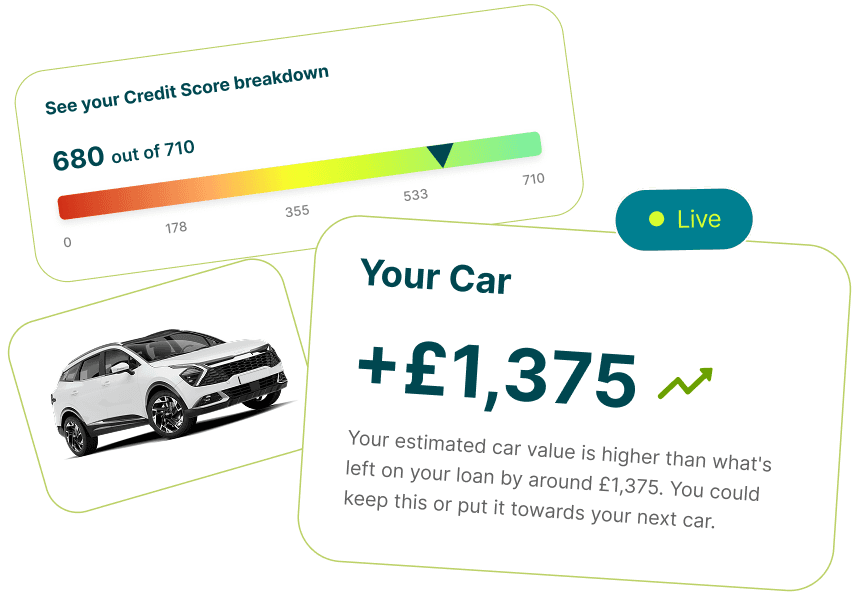
Track what your car’s worth, what you owe, and when it’s the right time to change - all in one simple score.
UK inflation hit 3.5% in September, driven by fuel. Here's how to cut your running costs, and when swapping to a hybrid or EV makes sense.
Read more
Most drivers held off changing car until after the Budget. Here's what it changed for motorists and how to decide whether to move now or wait.
Read more
Waiting on a car finance commission complaint? Here's what selling, settling or swapping your car does — and doesn't — change, plus what paperwork to keep.
Read moreUK inflation hit 3.5% in September, driven by fuel. Here's how to cut your running costs, and when swapping to a hybrid or EV makes sense.
Read moreMost drivers held off changing car until after the Budget. Here's what it changed for motorists and how to decide whether to move now or wait.
Read moreWaiting on a car finance commission complaint? Here's what selling, settling or swapping your car does — and doesn't — change, plus what paperwork to keep.
Read more
TAL Marketing Group Limited trading as swoppa is registered in England and Wales under company number: 10612899. Registered Office Address: Work Life, Brown Street, Manchester, England, M2 1DH.
TAL Marketing Group Limited t/a swoppa is an appointed representative of Creative Finance Corp LTD under reference FRN 968428. Creative Finance Corp LTD is authorised and regulated by the Financial Conduct Authority under reference FRN 702435, and is the principal firm of TAL Marketing Group Limited. We act as a credit broker not a lender. We work with a number of carefully selected credit providers who may be able to offer you finance for your purchase. (Written Quotation available upon request.) Whichever lender we introduce you to, we will typically receive commission from them (either a fixed fee or a fixed percentage of the amount you borrow) and this may or may not affect the total amount repayable. The lender will disclose this information before you enter into an agreement which only occurs with your express consent. The lenders we work with could pay commission at different rates and you will be notified of the amount we are paid before completion. All finance is subject to status and income. Terms and conditions apply. Applicants must be 18 years or over. We are only able to offer finance products from these providers. As we are a credit broker and have a commercial relationship with the lender, the introduction we make is not impartial, but we will make introductions in line with your needs, subject to your circumstances.
TAL Marketing Group Limited t/a swoppa are registered with the Information Commissioner's Office under registration number ZB241343.Your details will be shared with 3rd parties, where it is necessary for our legitimate interests (or those of a third party) and your interests, and your fundamental rights do not override those interests, such as companies that can improve your current financial circumstances