Free Car Valuation
- Check your car’s real value
- Free forever
- No credit score impact
- See if you're losing money


More than just a number
Your car's value: What your car is worth in today's market, based on its make, model, age and mileage.
What you still owe: If your car's on finance, see your outstanding balance alongside its value, without phoning your lender.
Your equity and swoppa score: See what's really yours once the finance is cleared, and whether now's a good time to change.
How much is my car worth?
Your car is worth what a buyer will realistically pay for it today. That figure depends on your car's make, model, age, mileage and condition, and on how much demand there is for cars like yours right now.
That's why you'll often see different numbers on different sites. Some show what a dealer might pay you, some show what you could get selling privately, and some show what a dealer would sell your car for on the forecourt. None of them is wrong, they're answering slightly different questions. The most useful number is the one that matches how you plan to sell.
And if your car's on finance, its value is only half the answer. You'll also need to know what it would cost to clear what you owe.
What affects your car's value?
- Mileage. Generally, the fewer miles, the higher the value. Cars that have done well above the average for their age are worth noticeably less.
- Age. Cars lose value fastest in their first few years, then depreciation slows down.
- Condition. Scratches, dents, worn tyres and interior wear all knock money off. A clean, well-kept car stands out.
- Service history. A full, stamped service history reassures buyers and supports a higher price.
- Specification. Popular options like sat nav, parking sensors, heated seats and higher trim levels can add value.
- Colour. Neutral colours like black, grey, white and silver tend to be easiest to sell.
- Fuel type. Demand for petrol, diesel, hybrid and electric cars shifts with fuel prices, running costs and clean air zones.
- Time of year. Convertibles sell better in spring and summer, 4x4s in autumn and winter. New registration plates in March and September also move the market.
- Demand. Some makes and models simply hold their value better than others because more people want them.
| Value type | What it means | Usually |
|---|---|---|
| Part-exchange | What a dealer will knock off the price of your next car | Lowest |
| Trade / instant sale | What a car-buying service or dealer will pay you outright | Low to middle |
| Private sale | What another driver might pay you directly | Higher |
| Retail | What a dealer would sell your car for | Highest |
Dealers need room to recondition, advertise and make a profit, so their offers sit below what you'd pay to buy the same car from them. Selling privately usually gets you more, but takes more time and effort.
Car on finance? Value is only half the story
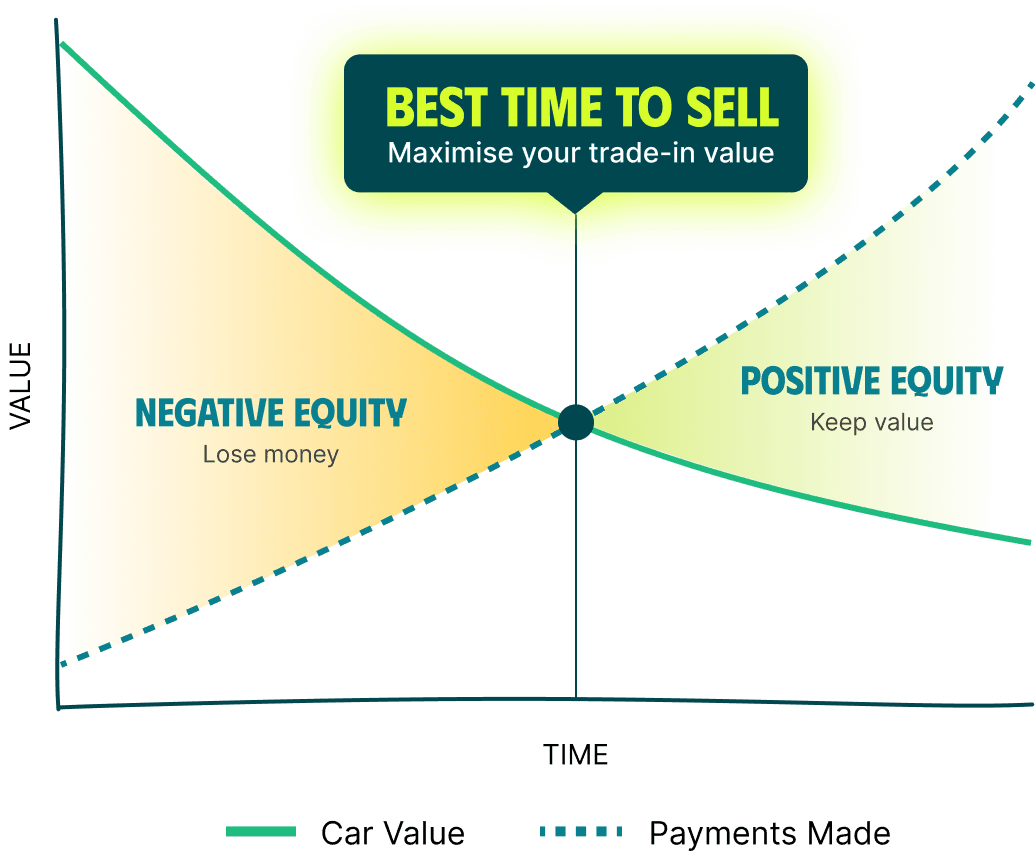
If your car's on PCP or HP, it isn't fully yours until the finance is paid off. So when you sell or swap it, the first thing that happens is that your lender gets paid. What's left over — or what's missing, is your equity.
Your car's value: your settlement figure = your equity
Say your car is worth £14,000 and your settlement figure is £16,000. You're in £2,000 of negative equity. Sell it today and you'd still need to find £2,000 to clear your finance.
Now say your car is worth £14,000 and you owe £10,000. You've got £4,000 of positive equity, which could go straight towards your next car.
Most valuation sites only show you the first number. swoppa shows you both, along with your swoppa Score, so you know whether now's a good time to change or whether waiting will put you in a better position.
Want to understand it in more detail? Read car equity explained or find out whether you can part-exchange a car with outstanding finance.
How to get a higher valuation
- Gather your paperwork. Service history, MOT certificates and receipts for work done all build buyer confidence.
- Fix the small stuff. Minor scratches, chips and a warning light can cost more in a lower offer than they would to repair.
- Give it a proper clean. A valeted car looks better cared for, inside and out.
- Get more than one offer. Compare part-exchange, instant sale and private sale prices before you decide.
- Time it well. Values can shift around the new plate months and with the seasons.
- Track it. Your car's value and what you owe both change every month. Keeping an eye on them helps you spot the right moment to sell or swap.

Frequently Asked Questions
Selling with swoppa
Selling your car with swoppa
Selling your car is not just about finding a buyer. It is about knowing when the decision actually makes sense for you.
Many people sell too early and lose value. Others wait too long and limit their options. The difference is not luck. It is clarity.
swoppa helps you understand exactly where you stand before you act. Partnering with Motormoolah, swoppa offers a quick and simple valuation to help you get started. By bringing together your car's value, your finance balance, and your overall position, you can decide with confidence rather than guesswork.
No pressure. Just clarity.

TAL Marketing Group Limited trading as swoppa is registered in England and Wales under company number: 10612899. Registered Office Address: Work Life, Brown Street, Manchester, England, M2 1DH.
TAL Marketing Group Limited t/a swoppa is an appointed representative of Creative Finance Corp LTD under reference FRN 968428. Creative Finance Corp LTD is authorised and regulated by the Financial Conduct Authority under reference FRN 702435, and is the principal firm of TAL Marketing Group Limited. We act as a credit broker not a lender. We work with a number of carefully selected credit providers who may be able to offer you finance for your purchase. (Written Quotation available upon request.) Whichever lender we introduce you to, we will typically receive commission from them (either a fixed fee or a fixed percentage of the amount you borrow) and this may or may not affect the total amount repayable. The lender will disclose this information before you enter into an agreement which only occurs with your express consent. The lenders we work with could pay commission at different rates and you will be notified of the amount we are paid before completion. All finance is subject to status and income. Terms and conditions apply. Applicants must be 18 years or over. We are only able to offer finance products from these providers. As we are a credit broker and have a commercial relationship with the lender, the introduction we make is not impartial, but we will make introductions in line with your needs, subject to your circumstances.
TAL Marketing Group Limited t/a swoppa are registered with the Information Commissioner's Office under registration number ZB241343.Your details will be shared with 3rd parties, where it is necessary for our legitimate interests (or those of a third party) and your interests, and your fundamental rights do not override those interests, such as companies that can improve your current financial circumstances