Fuel costs are driving inflation up. Is it time to swap to a cheaper-to-run car?
UK inflation hit 3.5% in September, driven by fuel. Here's how to cut your running costs, and when swapping to a hybrid or EV makes sense.
Read more
Most drivers know their car's make, model and mileage. Far fewer know its equity.
Car equity is simply the gap between what your car is worth and what you still owe on it. It sounds small, but it's one of the most useful numbers in your financial picture. It tells you whether you're in a strong position or a stretched one, and it shapes every decision that comes next — selling, refinancing, trading in, or upgrading sooner than planned.
Thousands of drivers go into a dealership or start a finance application without knowing this number at all. That's not their fault. Settlement figures change monthly, valuations shift with the market, and nobody sends you a text to say "hey, your equity just moved." So most people are working from a guess.
You don't have to be one of them.
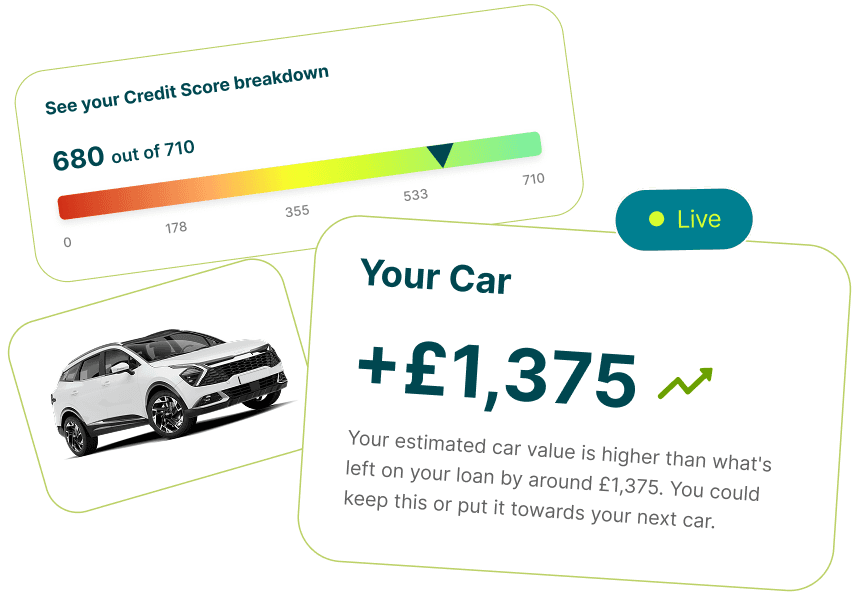
Want to know your real position? swoppa shows your car's value, remaining finance and swoppa Score in minutes. Click here to learn more.
Car equity is the difference between what your car is currently worth and what you still owe on any finance agreement attached to it.
If your car is worth more than you owe, that difference is yours — it's positive equity, and it's money you could put toward your next car, a lower monthly payment, or just peace of mind. If you owe more than the car is worth, you're in negative equity, which means there's a shortfall to cover before you're free and clear.
It's an easy idea to grasp, but it's also easy to confuse with two related figures:
Equity is the space between those two numbers, and that space moves every month. Cars depreciate steadily, especially in their first few years, while your finance balance falls at its own pace depending on your agreement type and deposit. When depreciation outpaces your repayments, equity shrinks. When your repayments move faster than the car's value drops, equity grows.
Current Market Value
minus
Outstanding Finance
=
Car Equity
Example: A car worth £16,000 with £11,000 left to settle leaves you with £5,000 in equity.
Working out your own equity takes three steps.
Step 1 — Find your settlement figure. This is the exact amount needed to pay off your finance agreement today, not the sum of your remaining monthly payments. Your finance provider can give you this figure directly, and it usually only takes a few minutes to request.
Step 2 — Find your vehicle's current market value. A few options here, and it's worth checking more than one:
Step 3 — Subtract one from the other. Market value minus settlement figure equals your equity. A positive number means you're ahead. A negative number means there's a shortfall to plan around.
Car's worth: £18,000
Finance remaining: 12,500
Result: £5,500 positive equity
Car's worth: £14,000
Finance remaining: £17,000
Result: £3,000 negative equity
Positive equity means your car is worth more than you owe on it. It usually happens when you've paid down enough of your finance, made a decent deposit, or your car has held its value better than average.
It's a good place to be. It means:
Negative equity means you owe more than the car is currently worth. It's common, especially in the first year or two of a PCP agreement, and it doesn't mean you've done anything wrong. It's usually just the maths of depreciation moving faster than repayments early on.
Typical causes include:
| Positive Equity | Negative Equity |
|---|---|
| Car worth more than finance owed | Finance owed is higher than car's value |
| Easier to upgrade | May need to carry debt into the next deal |
| Better finance options available | Fewer options, often at higher cost |
| Can use equity as a deposit | May need to find extra deposit to cover the gap |
It depends on the type of agreement you're in. PCP, Hire Purchase and leasing all work differently when it comes to equity.
You can build equity on a PCP agreement, particularly if your car has held its value well or you've made a solid deposit. Because part of the balance sits in a final "balloon" payment, equity can move around more than it does on other agreement types — it's worth checking yours rather than assuming.
Hire Purchase usually builds equity more steadily. Since there's no balloon payment, each monthly repayment chips away at the balance in a more predictable way, and equity tends to build in a straighter line.
With leasing, there's no ownership at any point, so there's usually no equity to speak of. You're paying for use of the car, not a stake in it, so this section mostly won't apply if you lease.
A few habits make a real difference over time:
If you're in negative equity, you've got options. None of them are instant, but all of them are workable.
If you're in positive equity, yes — and it's one of the most useful things you can do with it. That equity can go straight toward:
Using your equity this way only works if you know the number first — which is exactly the part most drivers skip.
You can work out your equity manually, and the steps above will get you there. But manual calculations often fall short of the full picture, because:
A calculator that pulls your finance position and current market value together in one place removes the guesswork — and keeps that number accurate as things shift. That's the gap swoppa is built to close.
Car values are never static. A number of factors move them, often at the same time:
This is why a valuation from six months ago isn't reliable today — and why checking regularly matters more than checking once.
Timing matters more than age. A car with fewer years on the clock isn't automatically the smarter one to change — the numbers behind it matter more:
Two drivers with identical cars can be in completely different positions depending on these factors. Knowing your own numbers, rather than going by instinct or mileage alone, is what makes the timing decision a confident one rather than a guess.
swoppa isn't just a calculator. It's a way to see your whole position clearly, in one place:
No pressure, no sales pitch — just clarity on where you stand, so the next move is yours to make with confidence.
Check your car's value and discover your swoppa Score today.
Car value is what your car is worth on its own. Car equity is that value minus what you still owe — it's the part that's genuinely yours.
Ready to see where you stand? Check your car's value and discover your swoppa Score today. Click here to learn more.

Track what your car’s worth, what you owe, and when it’s the right time to change - all in one simple score.
UK inflation hit 3.5% in September, driven by fuel. Here's how to cut your running costs, and when swapping to a hybrid or EV makes sense.
Read more
Most drivers held off changing car until after the Budget. Here's what it changed for motorists and how to decide whether to move now or wait.
Read more
Waiting on a car finance commission complaint? Here's what selling, settling or swapping your car does — and doesn't — change, plus what paperwork to keep.
Read moreUK inflation hit 3.5% in September, driven by fuel. Here's how to cut your running costs, and when swapping to a hybrid or EV makes sense.
Read moreMost drivers held off changing car until after the Budget. Here's what it changed for motorists and how to decide whether to move now or wait.
Read moreWaiting on a car finance commission complaint? Here's what selling, settling or swapping your car does — and doesn't — change, plus what paperwork to keep.
Read more
TAL Marketing Group Limited trading as swoppa is registered in England and Wales under company number: 10612899. Registered Office Address: Work Life, Brown Street, Manchester, England, M2 1DH.
TAL Marketing Group Limited t/a swoppa is an appointed representative of Creative Finance Corp LTD under reference FRN 968428. Creative Finance Corp LTD is authorised and regulated by the Financial Conduct Authority under reference FRN 702435, and is the principal firm of TAL Marketing Group Limited. We act as a credit broker not a lender. We work with a number of carefully selected credit providers who may be able to offer you finance for your purchase. (Written Quotation available upon request.) Whichever lender we introduce you to, we will typically receive commission from them (either a fixed fee or a fixed percentage of the amount you borrow) and this may or may not affect the total amount repayable. The lender will disclose this information before you enter into an agreement which only occurs with your express consent. The lenders we work with could pay commission at different rates and you will be notified of the amount we are paid before completion. All finance is subject to status and income. Terms and conditions apply. Applicants must be 18 years or over. We are only able to offer finance products from these providers. As we are a credit broker and have a commercial relationship with the lender, the introduction we make is not impartial, but we will make introductions in line with your needs, subject to your circumstances.
TAL Marketing Group Limited t/a swoppa are registered with the Information Commissioner's Office under registration number ZB241343.Your details will be shared with 3rd parties, where it is necessary for our legitimate interests (or those of a third party) and your interests, and your fundamental rights do not override those interests, such as companies that can improve your current financial circumstances